



















































































Where Should You Use XPS Insulation?
XPS Insulation
Extruded polystyrene is typically thought of as the automatic “go-to” option when it comes to the base walls areas, meaning below DPC level down to foundation level because it provides a high level of moisture resistance.
XPS is now finding new uses in other areas of buildings due to new formats with different texture and face finishes alongside choices of edge profiles that are being offered.
XPS is an abbreviation for “Extruded Polystyrene” and is fabricated with a closed cell structure, which makes it extremely water resistant.
This gives its unique benefits such as having high R-values, which thus, gives better thermal resistance. Extruded polystyrene is able to withstand a high level of compressive strength. Typically boards offer a standard grades of compressive strength of around 300 kPA. Some boards have strengths greater than >300kPA, which equates to weights in typical floor loading standards of construction of greater than 30,000 kilogram-force per square meter.
The testing of compressive strengths of the boards are calculated for either short-term strengths or longer, continuous strengths. For short-term strengths, the compressive strength of XPS boards is measured at a 10% deformation percentage, which is a conventional value used to determine the material's yield strength under compression testing standards like EN 826, ASTM C165 and ASTM D1621. For practical, long-term applications where minimal change in thickness is critical (such as under a concrete slab or in a car park), XPS boards are expected to exhibit a much lower deformation percentage over their lifespan compared to other board types.
To explain further how the tests are calculated, an applied load is increased until the material yields (fails) or compresses by 10% of its original thickness, whichever comes first.
Long-term stability tests are done for applications with continuous loads (for example under a concrete slab). In this scenario, a 2% deformation test is used.
XPS insulation is fully recyclable, giving it environmental benefits. The boards have an extremely long lifespan making them a reliable and cost saving product.
For installation, the boards can be cut with a clean knife, or sharp saw.
Generally, extruded polystyrene insulation doesn't require a separate vapour barrier. This is due to its closed-cell structure, which naturally provides a degree of moisture resistance.
Finishes:
Smooth Face Boards: Smooth, closed-cell XPS panels protect against moisture absorption and diffusion due to long-term water exposure. These boards are ideal for below DPC vertical insulation uses.
The foil-facing acts as a vapour barrier or radiant heat reflector. Ensure that the joints and screw heads are covered with a foil-faced tape and perimeters edges are fully sealed.
Rough Surface Boards: The textured or rough surface provides a better ‘keyed’ surface to apply external render (EWI systems), adhesives or plaster finishes as it increases the adhesion. This strong binding ensures the application of a wide variety of finishes that are held securely to the insulation, providing a long lasting application without future failure of the unbinding of the applied finishes.
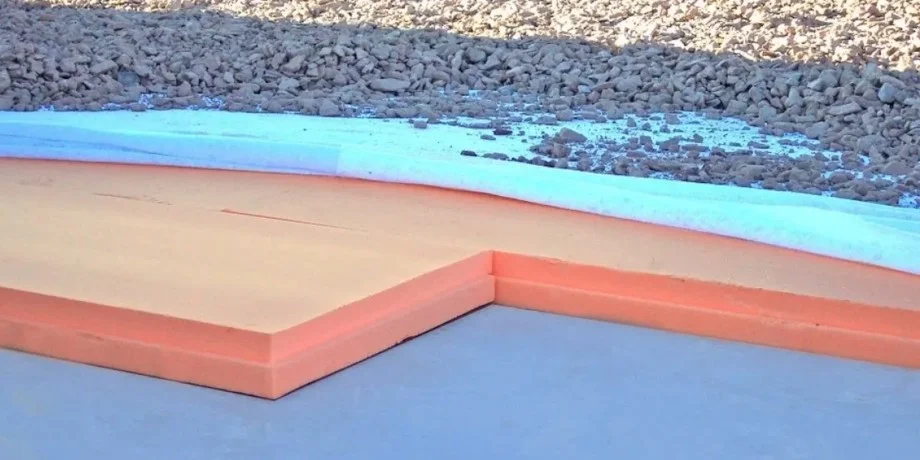
Panels with Grooves: Enhance wall drainage and thermal insulation for foundations. Grooves are ideal for warm, inverted roofs as, depending on the roof finish, allows for water flow and rainwater drainage and prevent thermal bridging. Its attributes for water resistance, strong compressive strength for finishes above, such as ballast, and the boards maintain their R-values over time and when wet. This ensures a consistent performance for areas such as car parks, roof terraces and green roofs.
Grooved boards are also very helpful with underfloor heating installation as the grooves provide linear tracks (channels), laid out to perfect spacings and to the appropriate depth, to lay the heating water pipes with ease and time efficiency. Boards are usually foil-faced to help direct the heat upwards (avoiding downwards heat travel), eliminating cold spots and improving the functionality of the heating system. The XPS boards provide a high strength material, allowing for the top floor finish to be applied directly over top. The boards are installed over a supportive structural base. The boards are practical in retrofit projects as they can be placed directly over most existing floor structures, and provide a more practical installation compared to laying the pipes within a concrete screed.
Profiles:
XPS boards come with different edge options from straight edge, rebated and tongue and groove boards.
There are advantages to rebated and tongue and groove boards as they help seal joints that might be left open with straight edge boards. The overlapped, rebated edges helps ensure air tightness through the construction element, minimising thermal cold bridging and thus increasing thermal efficiency and helps to ensure airtightness. Where gaps appear, either through straight edge boards or around rebated boards, it is advised to seal any gaps with expandable foam.
Where Should You Use XPS Insulation?
As mentioned, extruded polystyrene boards are the preferred boards for under DPC level but they can be used for many more applications of which we will discuss.
Insulation boards are designed principally for use on:
- facades
- perimeter areas,
- flat roofs (inverted roofs),
- underneath the foundation plate
- interior basements like floors
- Exterior to base areas under DPC
- Swimming pools
- Cavity closures
Swimming Pools
Some XPS boards are well suited for swimming pool lining construction such as Cellecta's Hexatherm XPOOL. The closed cell XPS board is ideal as its ultra high compressive strength with long-term static load characteristics and has extremely low water absorption rate. This allows the boards to be installed under the concrete slab and walls without the need for damp proof membranes. The boards are ideal for high humidity levels and provide a high thermal performance.
Cavity Closures
Cellecta offers a range of cavity closures that are made of Hexatherm extruded polystyrene within U-PVC damp proof course profiles. This cavity closer eliminates cold bridging around openings in the walls.
Reinforced XPS Tile backer boards
These boards are lightweight and provide a high performance construction, used for waterproofing, dry-lining and thermal insulation. It gives very good long-term adhesion.
One product is Marmox Multiboard Tile Backer, which consists of a core of XPS between layers of fibreglass reinforced polymer concrete. This layer provides the perfect level of porosity to bond with tile adhesive or plaster (making it an alternative to laminated thermal plasterboard). The extruded polystyrene layer not only provides thermal insulation but ensures the board is completely impermeable to water. The rigid outer shell and the XPS core, that absorbs lateral movement, makes the board an effective decoupling layer.
Thicknesses range from 4mm to 60mm. The board can be used on floors, walls and ceilings. It is easy to cut and shape to suit any design.
The boards are completely waterproof (not just water resistant), meaning that no water can be absorbed into the core of the board. This ensures that the boards will not bend, bow or distort.
Uses include wet rooms, steam room and swimming pools.
The Marmox Floor Backer is coated on one side only with a cement coating that is reinforced with a fibreglass mesh.
The Floor Backer Board is designed to be a cost effective way of creating a thermal barrier between cold concrete or a wooden substrate and tiles. The boards are ideal to be fixed directly over the surface of plasterboard walls or sheet wooden floors using a tile adhesive. Using this board forms an insulated and waterproof barrier. Note that the boards are not suitable for fixing direct to stud walls.
Marmox Floor Backer boards are available in only two thicknesses: 6mm and 10mm.
----------
Stephan Silver of Xobo Design