
























































































































Knauf Aquapanel Systems Guide
Knauf Aquapanel® Systems Guide
Introduction
Knauf Aquapanel® is a cement-based board system developed for use in externally exposed and high-moisture environments, as well as demanding internal applications. We will be discussing Knauf Aquapanel® systems as a whole, with a particular emphasis on exterior wall applications, including exterior ceilings and soffits. Simultaneously, we will discuss interior applications on walls, ceilings and floors.
Unlike gypsum-based boards, Aquapanel® boards are water-resistant and able to support harsh weather conditions. They are, mould and mildew resistant thanks to being made of inorganic materials. The boards are dimensionally stable, robust and durable and are non-combustible (with a rating of Euroclass A1), making them suitable for use in facade systems where fire performance is critical.
The Aquapanel® range comprises both Aquapanel® Outdoor (Exterior wall boards) and Aquapanel® Indoor (Interior wall boards), allowing a consistent cement-board technology to be used across facades, soffits, wet internal spaces and selected floor applications.
Spectacular seamless surfaces are possible thanks to expansion joints that are only needed every 15m and enable a 225 m2 closed area without a visible joint (A control/movement joint must be installed if there is a control/movement joint in the structure underneath.)
Aquapanel® Exterior Wall Board is not a structural sheathing board and does not provide racking resistance. It must be installed as part of a tested system build-up and always finished with an appropriate facade system.
Boards have a specialist fabrication process to provide reinforced edges for stronger, cleaner joints.
The system is BBA certified, NHBC, LABC and Premier Guarantee approved,
Curved boards:
Boards have a bending radius of 3 metres (full board) and 1 metre (formed from 300 mm wide strips). This allows for a variety of curved shapes and creative designs, including domes and arches. Moreover, by using double studs, it’s possible to create different interiors and exteriors: for example, a wall that’s concave on the outside, and convex on the inside.
I. Aquapanel® Board Types and Intended Applications
A) Aquapanel® Outdoor – Exterior Wall Board
Aquapanel® Exterior Wall Boards (12.5mm thick - Sizes: 900mm x 1200mm and 900mm x 2400mm) are designed for use as a render carrier and façade backing board, mainly intended for use in rear-ventilated rain screen facade or drywall solution wall constructions.
The exterior boards are lightweight at 11 Kg/sq.m making for easy handling. They are easy to cut with a score and snap method and do not require pre-drilling, allowing for an installation with relative ease and time efficient.
For finishings, there is a large choice of colours, textures available with different external render systems. They come ready, being keyed for tiling - with only one layer required for a tile finish. There are options for the creation of curved walls, claddings and ceilings.
Typical applications include:
Exterior System 1)
AQUAPANEL® Exterior Wall – rear-ventilated rainscreen facade
With rainscreen facades for use above solid substructures such as brick or concrete, thermal insulation is separated from the weather protection materials ensuring a constant flow of air in the ventilated space to remove moisture from the building and to optimise indoor climate. Even if the facade is damaged, the insulation remains intact.
Exterior System 2)
AQUAPANEL® Exterior Wall – drywall solution
Drywall systems are available as single stud solutions with a variety of creative design options. And although it is most commonly used in skeleton constructions comprising reinforced concrete, drywall is also suitable for timber or lightweight steel-frame constructions.
Exterior System 3)
Ideal drylining solution for exterior ceilings such as soffits, canopies, undersides of balconies, underpasses and underground car parks, with proven resistance to moisture or mildew forming and spreading. Ideal for areas where resistance to moisture and freeze–thaw conditions is required. For greater safety and the highest standards in design, construction, cost-effectiveness and durability.
Ensure that adequate framing is installed to support the boards and design for the allowance for wind loadings. Ensure the use of corrosion-resistant fixings.
Options for external finishes: Knauf External Renders can be specified as a finish coat, offering options for texture and colours. The systems can also accommodate other materials, such as tiles.
Simple installation: The combination of lightweight materials and the simplicity of installation makes the overhead work easier and faster.
Aquapanel® Indoor boards (12.5mm thick - Sizes: 900mm x 1200mm and 900mm x 2400mm) are intended for internal wall and ceiling applications in areas subject to high moisture (even when exposed to chlorine), regular cleaning or increased impact. Typical uses include: bathrooms and showers, commercial kitchens, swimming pools and leisure facilities, plant rooms and service areas.
Aquapanel® Indoor boards provides a solid, stable, durable, water-resistant substrate for tiling or other decorative finishes and is used where moisture-resistant plasterboard would be unsuitable and where log-term durability is required.
C) Aquapanel® Cement Board SkyLite
Knauf Aquapanel Cement Board SkyLite (8mm thick- Size: 900mm x 1200mm) is an extremely durable ceiling board that can be used in wet indoor areas such as bathrooms, shower rooms and wet rooms as well as some exterior soffits, dependent on specification. Knauf Aquapanel Skylite is resistant to mould and mildew and doesn't get wet. Knauf Aquapanel Skylite can be installed with no special tools.
D) Knauf Rooftop Aquapanel Cement Board
There are two thickness available: 12.5mm thick, typically used for standard roofing and as a substrate board over a steel deck and 6mm thick, which is typically used as a cover board on top of insulation) and for special lighter-duty applications.
Sizes: 900mm wide with lengths of 1200 mm and 2400 mm, with some variations like 2250 mm also available.
Knauf Rooftop Aquapanel® Cement Board is an extremely durable construction board highly resistant to moisture, mould and mildew growth. It can be used as a cover board above the insulation and as a substrate to take on the waterproofing layer. Knauf Aquapanel Cement Board Rooftop board is highly impact resistant and gives extra strength to the roof cover. The board edges are reinforced for extra strength. The panel provides a solid base that withstands extreme weather conditions.
Aquapanel® Floor Tile Underlay
Aquapanel® Floor Tile Underlay (6mm thick - 900mm x 1200mm) is used internally as a tile backing board on floors, typically over timber or engineered subfloors. It improves load distribution, limits movement beneath tiled finishes and is compatible and stable under heat, for example, with underfloor heating systems in domestic and light commercial applications, and in areas requiring durable tiled floors. Always follow and install in accordance with manufacturer guidance.
It is suitable for wet and humid environments such as bathrooms, showers and wet rooms, kitchens and utility rooms where water exposure is common.
II. Exterior Wall Applications – System Logic and Performance
Aquapanel® Exterior Wall systems are most commonly used in:
- Low to mid-rise residential construction
- Commercial and mixed-use developments
- Education, healthcare and public buildings
- Refurbishment and recladding projects
In external wall construction, Aquapanel® functions as a durable, non-combustible render carrier board positioned outside the primary weather and airtight layers of the building envelope. The board itself does not provide weather-tightness; instead, it forms part of a drained and ventilated façade system.
Typical façade finishes applied over Aquapanel® include thin-coat or traditional render systems, brick slips systems, ceramic or porcelain tile systems, rain screen cladding systems with a rendered backing zone.
External Wall Construction Principles
Relationship to the Primary Wall Structure
Whether the loadbearing structure is timber frame or steel frame (SFS), the fundamental Aquapanel® exterior wall build-up remains the same. Aquapanel® is installed outside the main wall structure, separated from it by a drained and ventilated cavity. Differences between timber and steel framing relate primarily to fixings, movement allowances and fire strategy, rather than to the Aquapanel® system itself.
Typical External Wall Build-Up Sequence
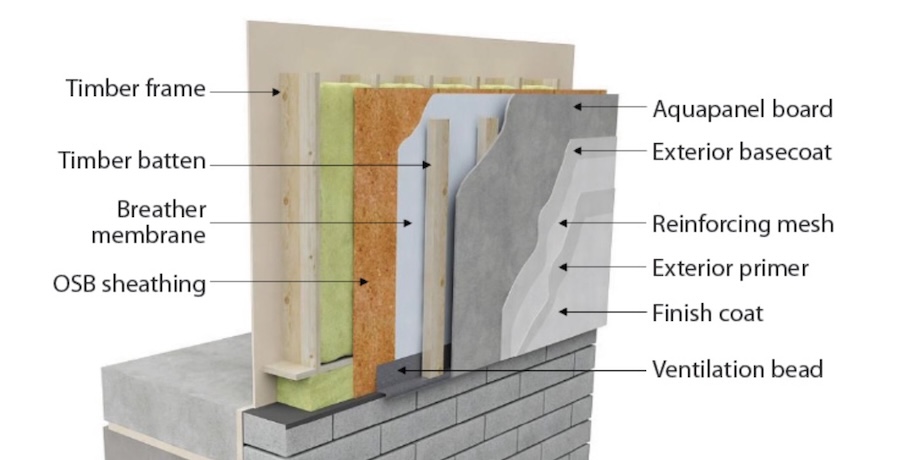
A correct external wall build-up using Aquapanel® Exterior Wall Board generally comprises the following layers, from inside to outside:
- Loadbearing wall structure: Timber studs or steel frame (SFS)
- External sheathing board: Fixed to the outside face of the studs, providing a racking resistance and backing to membranes
- Breather membrane: Installed externally over the sheathing board. It should be applied as a continuous whole with edged overlapped, taped and sealed.
- Ventilated and drained cavity: to a minimum 50 mm, formed by vertical and horizontal battens.
- Knauf Aquapanel® Exterior Wall Board: Mechanically fixed to battens using Knauf specialist stainless steel screws.
- Render system (EWI-type): including a first layer basecoatt with full reinforcing mesh applied across the entire wall area, topped by a second basecoat and finished with a coat of decorative render. Render must be applied in accordance with BS EN 13914-4:2005 (Code of Practice for External Rendering).
This build-up applies equally to timber and steel framed construction when Aquapanel® is used as a ventilated render carrier system.
Installation Principles – Exterior Walls
Fixings and Board Layout
- Apply Knauf Aquapanel® Exterior horizontally to members at maximum 600mm centres. Ensure there is a gap of 3–5mm between the boards and that the members are central behind both boards.
- When fitting Knauf Aquapanel® Exterior, ensure that the vertical joints are centrally aligned to the board below and board edges are staggered, alternating, between boards at corners.
- Boards are installed with staggered joints, similar to masonry bonding patterns and staggered ends at corners.
- When fitting Knauf Aquapanel® Exterior around windows and doors ensure that no vertical joints coincide at window and door corners as this may allow moisture ingress. Ie, boards are “L” shaped cut around wall openings.
- Use Knauf Aquapanel® Maxi Screws to fix the boards to metal members.
- Use Knauf Aquapanel® Exterior Stainless Steel Screws to fix the boards to the timber members.
- Screws should be at least 15mm in from the edge of the Knauf Aquapanel Exterior and spaced at maximum 250mm centres.
- Screws should not be over tightened (installed flush with the board surface and not countersunk).
Joints
- Immediately after installing the Knauf Aquapanel® Exterior, protect the framework from weathering by filling and taping joints. All joints must be reinforced using Aquapanel® joint tape and joint filler.
- Joint reinforcement is embedded and skimmed to create a continuous reinforced surface.
- Reinforce window and door corners with extra pieces of reinforcing mesh, cut to size 50 x 30cm, embedded into exterior basecoat as per corner profiles.
- Proper joint treatment is essential for the long-term durability and crack resistance of the façade.
Weather Exposure During Construction
- Aquapanel® Exterior Wall Boards are weather-resistant but should not remain installed without a final top finish for more than six months.
- Temporary protection should be provided where required until joint treatment and basecoat application are complete.
Finishes
- Aquapanel® Exterior Wall Boards must always receive a compatible façade finish.
- Render systems must be applied in accordance with the render manufacturer’s system specification, including primers, basecoats, reinforcement mesh and top coats.
Compliance and Good Practice
- Aquapanel® Boards must be installed as part of a complete, tested system.
- Fire performance, acoustic requirements and thermal performance must be assessed at wall-build-up level.
- Cavity barriers, fire stopping and all detailing must comply with current Building Regulations and manufacturer’s guidance.
- Always refer to Knauf technical literature for full installation details and system limitations.
Knauf Aquapanel® systems provide a robust, non-combustible and moisture-resistant solution for both external and internal construction. While exterior wall applications represent the most demanding and widely used application of the system, the same cement-board technology extends effectively to soffits, wet internal spaces and floor tile underlays. When designed and installed correctly, Aquapanel® forms a reliable component within modern building-envelope and interior construction systems.