
































































































































The Science of Soundproofing: How to Block Unwanted Noise in Your Home
The Science of Soundproofing: How to Block Unwanted Noise in Your Home
Dealing with unwanted noise can be incredibly frustrating. Whether it is heavy footsteps from the apartment above, a loud television through the party wall, or traffic outside your bedroom window, noise pollution can seriously impact your quality of life.
However, fixing a noise problem requires a bit more than just throwing down a thick rug or hanging some curtains. To effectively block sound, you need to understand how it travels. In this post, we will explore the science of soundproofing, how it actually works, and how to separate the facts from the common myths, so you can finally get some peace and quiet.
Understanding How Sound Travels
To tackle a noise problem, you first need to identify what type of sound you are dealing with. Sound is an energy, and in a building, it primarily travels in two ways:
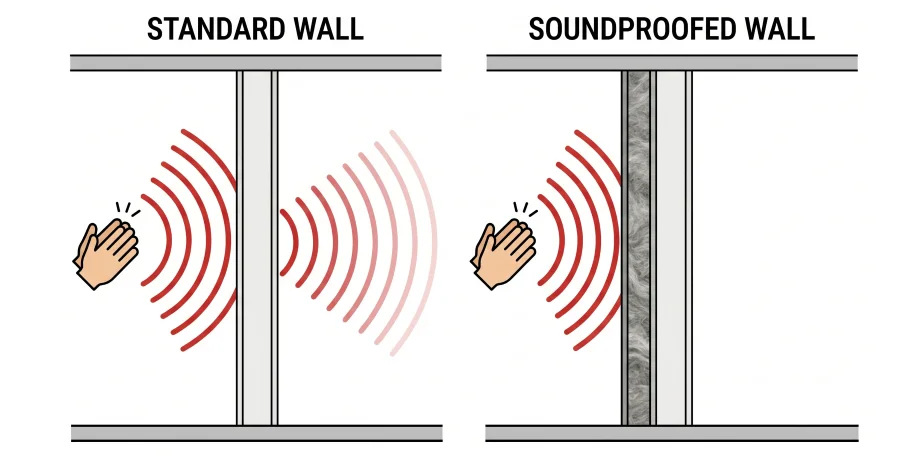
- Airborne Noise: These are sound waves that travel through the air. Common examples include people talking, music, dogs barking, or television noise.
- Impact and Vibration Noise: This is physical energy that travels through a building's structure. Examples include heavy footsteps on floorboards, doors slamming, moving furniture, or a vibrating washing machine.
Sound is measured in decibels (dB). Because the decibel scale is logarithmic, an increase of just 10 dB sounds to the human ear like the noise has doubled in volume. When soundproofing against airborne noise, you want a system that offers a higher dB reduction. For impact noise, you want a lower dB transfer rating.
The Three Golden Rules of Soundproofing
If you want to know how to stop noise, you have to look at the physics. To effectively block sound from travelling from one room to another, a soundproofing system must employ a combination of three scientific principles.
1. Mass
Heavy, dense materials block sound better than light, thin ones. Adding mass to a wall, floor, or ceiling (using heavy materials) means that airborne sound energy is reflected back into the room or converted into heat rather than passing through the structure.
2. Decoupling
Decoupling involves physically separating one structure from another. If you have impact noise travelling through the wooden joists of your ceiling, adding mass will not be enough. You must break the path of the vibrations. This is often done using resilient clips and metal channels to suspend a new ceiling or wall slightly away from the existing framework.
3. Absorption
When you build a stud wall or a suspended floor, you create an empty cavity. Sound can get trapped in this cavity and echo, making the noise worse. Adding internal dampening materials into these gaps absorbs the sound energy and stops it from amplifying.
Soundproofing vs. Sound Absorption: Busting the Big Myth
The most common mistake people make when trying to reduce noise is confusing sound absorption with sound proofing.
- Sound Absorption: Materials like acoustic foam panels, rugs, cushions, and heavy curtains absorb sound that is bouncing around inside a room. They stop echoes and make a room sound better internally, but they will not stop external noise from entering or leaving your home.
- Soundproofing: Requires dense mass and structural decoupling to physically block sound waves from passing through a solid structure.
If your neighbours are loud, sticking foam egg-carton panels to your wall will unfortunately not help. You need actual soundproofing materials.
Which Soundproofing Materials to Use?
Because effective soundproofing relies on a combination of mass, decoupling, and absorption, you should use a combination of materials for the best results:
- For Mass: Use acoustic plasterboard (which is much denser than standard plasterboard) or mass-loaded vinyl (a heavy, flexible sheet that blocks airborne noise).
- For Decoupling: Use specialist acoustic clips and isolation channels to separate your new wall or ceiling from the existing structure.
- For Absorption: Use acoustic mineral wool inside the cavities of your walls, floors, and ceilings. This is a dense, fibrous insulation that absorbs trapped sound energy perfectly.
Tip: You can find all of these high-quality acoustic insulation products right here at Insulation Shop.
When Does Soundproofing Work?
Soundproofing works when you apply the correct principles to the specific type of noise you are experiencing, and—most importantly—when you leave absolutely no gaps.
Think of soundproofing like waterproofing. If you are in a car and leave the window open just a tiny crack, you can still hear all the traffic outside perfectly. If you soundproof a whole wall but leave a small gap around a plug socket or skirting board, the noise will "leak" right through. Soundproofing is highly effective when installed correctly, using the right combination of high-mass materials, and when all perimeters are tightly sealed with acoustic sealant.
Actionable Steps for Homeowners and Renters
If you own your home: You have the freedom to install specialist acoustic systems. The best results come from opening up walls or lifting floors, filling the cavities with acoustic mineral wool, using isolation clips, and finishing with dense acoustic plasterboard.
If you rent (or are on a budget):
- Seal the Leaks: Apply acoustic seals to the gaps around and under your internal doors. Hollow doors with gaps around the frame let a massive amount of noise through.
- Upgrade Windows: Use secondary glazing kits or window draught seals to block external airborne noise from the street.
- Talk it Out: Sometimes, the cheapest and most effective first step is having a polite conversation with your neighbour. They may simply not realise how easily sound travels through the building's structure.
FAQs about Soundproofing
Which underlay is best at soundproofing?
The best soundproofing underlay depends on the noise you are trying to stop. For impact noise (footsteps), a thick, high-density sponge or rubber crumb underlay works brilliantly to absorb vibrations. However, if you are also trying to block airborne noise (voices or TV from below), you should look for an acoustic underlay that incorporates a layer of mass-loaded vinyl to add heavy, sound-blocking density to your floor.
Can I soundproof just one wall?
Yes, you can soundproof a single party wall to stop noise from a neighbour. However, keep in mind "flanking noise"—which is sound travelling around the wall through connected floors, ceilings, or adjacent walls. For very loud noise, you may need to treat those connecting structures as well.
Do "soundproof" paints or wallpapers work?
No. The science of soundproofing requires heavy mass and decoupling. Paint and wallpaper are far too thin and lightweight to block sound waves from passing through a wall.
FAQs about Insulation Shop
Do you sell soundproofing materials?
Yes! At Insulation Shop, we stock a wide variety of acoustic insulation products, including acoustic mineral wool, sound-blocking boards, and specialist soundproofing accessories suitable for walls, floors, and ceilings.
Can your technical team help me choose the right acoustic products?
Absolutely. Soundproofing can be complex, and buying the wrong material is a common mistake. Our expert team is on hand to discuss your specific noise problem and recommend the exact materials you need to achieve peace and quiet.
Do you deliver acoustic insulation directly to my home?
Yes, we provide fast and reliable delivery across the UK. Soundproofing materials are notoriously heavy and dense (which is why they work so well!), so our delivery service ensures your products arrive safely at your door, saving you the heavy lifting from a building merchant.